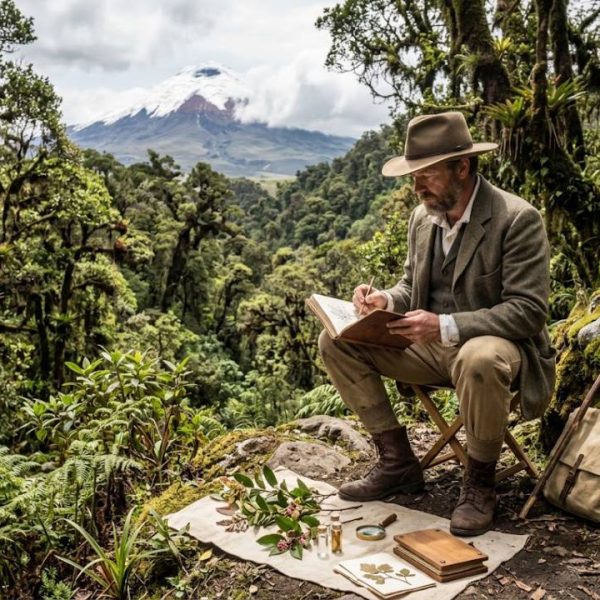
In June 1802, a 32-year-old Prussian scientist stood on the slopes of Chimborazo in Ecuador, then believed to be the highest mountain in the world. His feet were bleeding, his companions were suffering from altitude sickness and a deep crevasse blocked the way. Alexander von Humboldt turned back a few hundred metres below the summit. He had climbed higher than any European before him, and what he saw on the way up would change how we understand the planet.
Humboldt's big insight was simple and radical: nature is a web of connections, not a list of separate things.
A restless young Prussian
Humboldt was born in Berlin in 1769 into a wealthy family. His older brother Wilhelm became a famous linguist and education reformer, the founder of what is now Humboldt University. Alexander studied finance, mining and natural sciences, worked as a mining inspector and spent his spare time conducting experiments on electricity in animal tissue, sometimes on himself.
When his mother died in 1796, he inherited a fortune. He used it to fund the journey he had dreamed of since childhood.
Five years in the Americas
From 1799 to 1804, Humboldt travelled through what are now Venezuela, Cuba, Colombia, Ecuador, Peru and Mexico with the French botanist Aimé Bonpland. They paddled up the Orinoco, mapped the connection between the Orinoco and Amazon river systems, measured temperatures, altitudes and magnetic fields, and collected tens of thousands of plant specimens.
On Chimborazo, Humboldt noticed that vegetation changed with altitude in bands, much as it changes with latitude from the equator to the poles. He later drew this in his famous Naturgemälde, a cross-section of the mountain showing plants, temperatures and atmospheric data side by side. It is often described as one of the first infographics in science.
Inventing ideas we now take for granted
Humboldt introduced or popularised several concepts that remain central to earth science:
- Isotherms, lines on maps connecting places with the same average temperature.
- Vegetation zones, the idea that climate shapes plant communities in predictable ways.
- Early warnings about human-induced climate change, after seeing how deforestation dried out Lake Valencia in Venezuela.
- A global network of magnetic observatories to study the Earth's magnetic field.
He also showed that volcanoes appeared in chains linked to underground structures, a step towards understanding the forces that shape continents.
Kosmos, his life's work
Back in Europe, Humboldt spent decades writing up his findings. His travel accounts ran to some thirty volumes. In old age he began Kosmos, an attempt to describe the entire physical universe in one work. Four volumes appeared in his lifetime and a fifth after his death in 1859. Kosmos was a bestseller in German and was quickly translated into many languages.
Humboldt influenced an extraordinary range of people. Charles Darwin carried his travel narrative on the Beagle and called him the greatest scientific traveller who ever lived. Henry David Thoreau, John Muir and the poet Goethe all drew inspiration from him. Simon Bolívar, whom he met in Paris, said Humboldt had discovered the New World more fully than the conquistadors.
Why translation keeps Humboldt alive
Much of Humboldt's work was written in German and French, often in long, dense sentences full of scientific detail. Nineteenth-century English translations were incomplete and sometimes misleading. Only in recent decades have scholars produced fuller English editions of key works.
Researchers and publishers working on these projects rely on professional german translation services to handle both the historical language and the technical vocabulary. A word like "Naturgemälde" has no simple English equivalent, and translators must decide whether to keep it, explain it or invent a new term.
Large editorial projects, with thousands of letters, diaries and manuscripts, are now managed digitally. Translators work in a cat translation tool that keeps terminology consistent across volumes, so that place names, plant species and scientific instruments are translated the same way every time. For teams spread across several countries, choosing the best translation tool for collaboration can be as important as choosing the right translator.
That same demand for exact wording shows up wherever science meets regulation. Manufacturers exporting equipment today depend on specialist technical translation services to render device labels, user instructions and safety notices so they comply with the rules of each market. A mistranslated unit, symbol or warning can delay a product launch or put a user at risk. Humboldt's translators worried about losing meaning; today's technical translators have to keep meaning legally exact.
His legacy today
More places, plants and animals are named after Humboldt than after almost any other person: the Humboldt Current off South America, the Humboldt penguin, Humboldt squid, and counties, towns and mountains across the Americas. The Alexander von Humboldt Foundation funds thousands of international researchers to work in Germany every year, continuing his tradition of scientific exchange.
Interest in Humboldt surged again after Andrea Wulf's 2015 biography, The Invention of Nature, which presented him as a forgotten father of environmentalism. Climate scientists and ecologists today often cite him as an early thinker about the planet as a single interconnected system.
Lessons for students and curious readers
Humboldt's life offers several lessons that remain relevant:
- Measure carefully, but never lose sight of the bigger picture.
- Combine disciplines. Humboldt mixed botany, geology, climatology and art.
- Share knowledge widely. He wrote for scientists and for the general public.
- Pay attention to human impact. His warnings about deforestation still ring true.
A connected view of the world
Humboldt died in Berlin at the age of 89, working until the end. His funeral drew thousands of mourners. He left behind a way of seeing that is now so common we hardly notice it: the idea that climate, plants, animals, rocks and people are all part of one system. Every time we talk about ecosystems or climate zones, we are speaking Humboldt's language, whether we know it or not.